Source Rockwool Honeycomb Clean Room Door for Labs
Find 30 rockwool honeycomb clean room door options for sterile environments. Compare stainless steel frames, fiberglass screens, and ISO5 grade specifications to select the right security and acoustic solution for your facility; compare the available evidence and request quotations based on your requirements.
Key considerations
Products List




Comprehensive Sourcing Guide
Rockwool Honeycomb Clean Room Door Sourcing Guide
Procurement teams must first distinguish between standard security doors and specialized clean room units, as the core keyword implies a specific construction designed for sterile environments. The observed product listings confirm that these doors utilize a rock wool or paper honeycomb core, often paired with stainless steel or aluminum alloy frames to ensure structural integrity and resistance to corrosion. Buyers should verify that the "Clean Room Door" designation aligns with the intended application, such as pharmaceutical manufacturing or electronics assembly, where air tightness and particle control are paramount.
When evaluating listings, it is critical to note that while some products offer swing or automatic opening methods, the specific configuration must match the facility's workflow requirements. The observed data indicates that these units often feature electrostatic powder coating and specific sealing mechanisms like 3M industrial tape or neutral silica gel to maintain the integrity of the clean environment. Sourcing decisions should prioritize suppliers who explicitly define the core material and sealing method, as these factors directly influence the door's ability to meet ISO 5 clean grade standards and prevent cross-contamination.
Product Scope and Observed Listing Signals
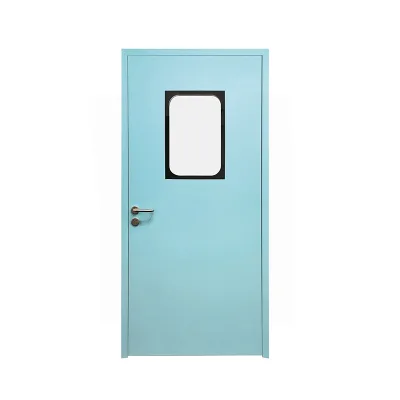
The market for rockwool honeycomb clean room doors presents a wide range of specifications, with observed sizes varying from 700mm to 1500mm in width while maintaining a standard height of 2100mm. Buyers must carefully review the listed dimensions, as the thickness is consistently noted at 50mm, which is essential for accommodating the core material and necessary hardware. The product scope includes various customization options for color, such as blue or custom finishes, and the ability to select between exposed or concealed door closers to suit aesthetic and functional needs.
Listing signals also reveal that these doors are frequently equipped with tempered glass windows, typically 5mm thick, framed in aluminum profiles to allow visibility without compromising the barrier. The observed product attributes highlight the availability of different hardware configurations, including handle locks, electromagnetic locks, and specific hinge types like SS304 or aluminum. Procurement teams should scrutinize these details to ensure the selected unit supports the required control modes, such as button operation, and integrates seamlessly with existing facility infrastructure like air showers or pass boxes.
Technical Specifications to Verify
Technical verification must begin with the core composition, ensuring the door utilizes rock wool or polyurethane (PU) rather than inferior materials that cannot withstand the rigorous demands of a clean room. The observed specifications confirm that steel thickness varies between 0.8mm and 1.5mm, a critical factor for durability and fire resistance. Buyers should request detailed material certificates to confirm the exact steel gauge and core density, as these parameters directly impact the door's acoustic performance, which is observed to range between 60-70db, and its overall structural longevity.
Further verification is required for the sealing system, which is observed to utilize 3M industrial tape and neutral silica gel to prevent air leakage. The door frame construction, often a combination of aluminum alloy and color baking steel, must be inspected for compatibility with the floor and wall sandwich panels used in the facility. Additionally, the presence of drop seals at the top and bottom is essential for maintaining the pressure differential required for sterilization and dust removal processes. Buyers must confirm that the specified window frames and glass thickness meet the necessary safety and transparency standards for the specific industrial application.
Compliance and Safety Documentation
Compliance documentation for clean room doors must address both general safety standards and specific industry requirements for sterile environments. While some listings mention ISO certifications, buyers should verify the exact standard, such as ISO 9001 for quality management or specific clean room classifications like ISO 5, rather than relying on generic claims. The observed data indicates that certifications are often custom-requested, meaning the supplier must provide valid, up-to-date documentation that aligns with the buyer's local regulatory framework and the specific needs of the facility.
Safety features are equally critical, with observed listings highlighting fireproof capabilities and moisture resistance as key attributes. The hardware components, including fire locks and specialized hinges, must be certified to withstand high temperatures and frequent use without failure. Buyers should demand test reports for the fireproof window design and the overall door assembly to ensure they meet the required fire rating. Additionally, the electric control systems should comply with UL or European standards to guarantee safe operation in environments where oxygen levels or negative ions are actively managed.
Cost Drivers and Commercial Terms
The cost of rockwool honeycomb clean room doors is driven primarily by the complexity of customization, the quality of the core material, and the specific hardware selected. Observed price ranges span from 42 to 1800 USD, reflecting the vast difference between basic swing doors and advanced automatic units with electromagnetic locks and specialized sealing. Buyers must understand that the inclusion of features like automatic opening mechanisms, specific color finishes, or custom-sized windows will significantly increase the unit price compared to standard configurations.
Commercial terms also vary based on the minimum order quantity (MOQ), which is observed to range from 1 to 200 units. For smaller projects, the per-unit cost may be higher due to setup fees, whereas bulk orders can leverage economies of scale. Lead times and shipping costs are influenced by the origin, typically China, and the complexity of the export packaging required to protect the finished surface. Procurement teams should negotiate clear terms regarding the delivery of custom-requested standards and the handling of any additional costs associated with specialized testing or certification.
Supplier Qualification and Quality Control
Supplier qualification requires a rigorous assessment of their manufacturing capabilities, particularly their ability to produce doors with consistent core density and precise sealing. Buyers should verify that the supplier has a proven track record in producing stainless steel and aluminum alloy doors for industrial applications, as evidenced by the observed product models like PH-900 and SZP. It is essential to confirm that the supplier can consistently deliver the specified steel thickness and surface finishing, such as electrostatic powder coating, without defects that could compromise the clean room environment.
Quality control processes must extend beyond the final product to include the inspection of raw materials and the assembly line. Buyers should request evidence of the supplier's internal testing procedures for the drop seals, hinges, and locking mechanisms to ensure they meet the durability and performance claims. The ability to provide custom designs for HEPA boxes and air showers indicates a supplier's capacity to integrate the door into a broader clean room system. Establishing a clear quality agreement that defines acceptable tolerances for dimensions and surface finishes is crucial for maintaining the integrity of the procurement.
Long-Term Procurement Checks
Long-term procurement success depends on the supplier's ability to provide reliable after-sales support and spare parts for the specialized hardware and sealing components. Buyers should establish a maintenance schedule that includes regular inspections of the door closer, hinges, and seals to ensure they continue to meet the 60-70db noise reduction and air tightness requirements. The observed use of 3M industrial tape and neutral silica gel suggests that these materials may require periodic replacement, making it vital to secure a supply chain for these consumables.
Furthermore, buyers must monitor the supplier's adherence to evolving industry standards and their capacity to adapt to new clean room technologies. As applications expand to include formaldehyde removal, humidification, and negative ion generation, the door system must remain compatible with these advanced functions. Regular audits of the supplier's production lines and quality control records will help ensure that future orders maintain the same high standards of fireproofing, moisture resistance, and acoustic performance. Building a long-term partnership with a qualified supplier ensures continuity and reliability for critical facility operations.
FAQs
What core materials are used in this clean room door?
The door core utilizes paper honeycomb, rock wool, or polyurethane options. These materials provide structural integrity and thermal insulation. The outer surface features electrostatic powder coating for durability. Stainless steel and aluminum alloy frames ensure long-term stability in industrial environments.
Can the door be customized for specific clean room sizes?
Yes, customization is available for various dimensions. Standard sizes include widths of 700mm, 800mm, and 1500mm with a height of 2100mm. The thickness is typically 50mm. Buyers can request specific widths and heights to fit unique architectural requirements for their facility.
Which certifications apply to these clean room doors?
The product holds ISOCE certification. It meets custom request standards for industrial applications. The design includes fireproof features and acoustic insulation. These attributes ensure compliance with general safety and environmental control requirements for sterile processing areas and industrial clean rooms.
What hardware options are included with the door assembly?
Hardware includes handle locks, electromagnetic locks, and door closers. Hinges are available in SS304 stainless steel or aluminum. The door closer can be exposed or concealed. Additional components like fire locks and specialized hinges are selectable to match operational needs.
How is sound insulation achieved in this door design?
Sound insulation follows a European style design. The core materials like rock wool contribute to acoustic dampening. The seal uses 3m industrial tape and neutral silica gel to prevent noise leakage. This ensures a quiet environment suitable for sensitive industrial or medical clean room operations.
What is the typical MOQ for ordering these doors?
The minimum order quantity ranges from 1 to 200 units. This flexibility supports both small pilot projects and large-scale facility deployments. Buyers can negotiate specific quantities based on their project scale. The packaging is designed for export to ensure safe delivery of the units.